
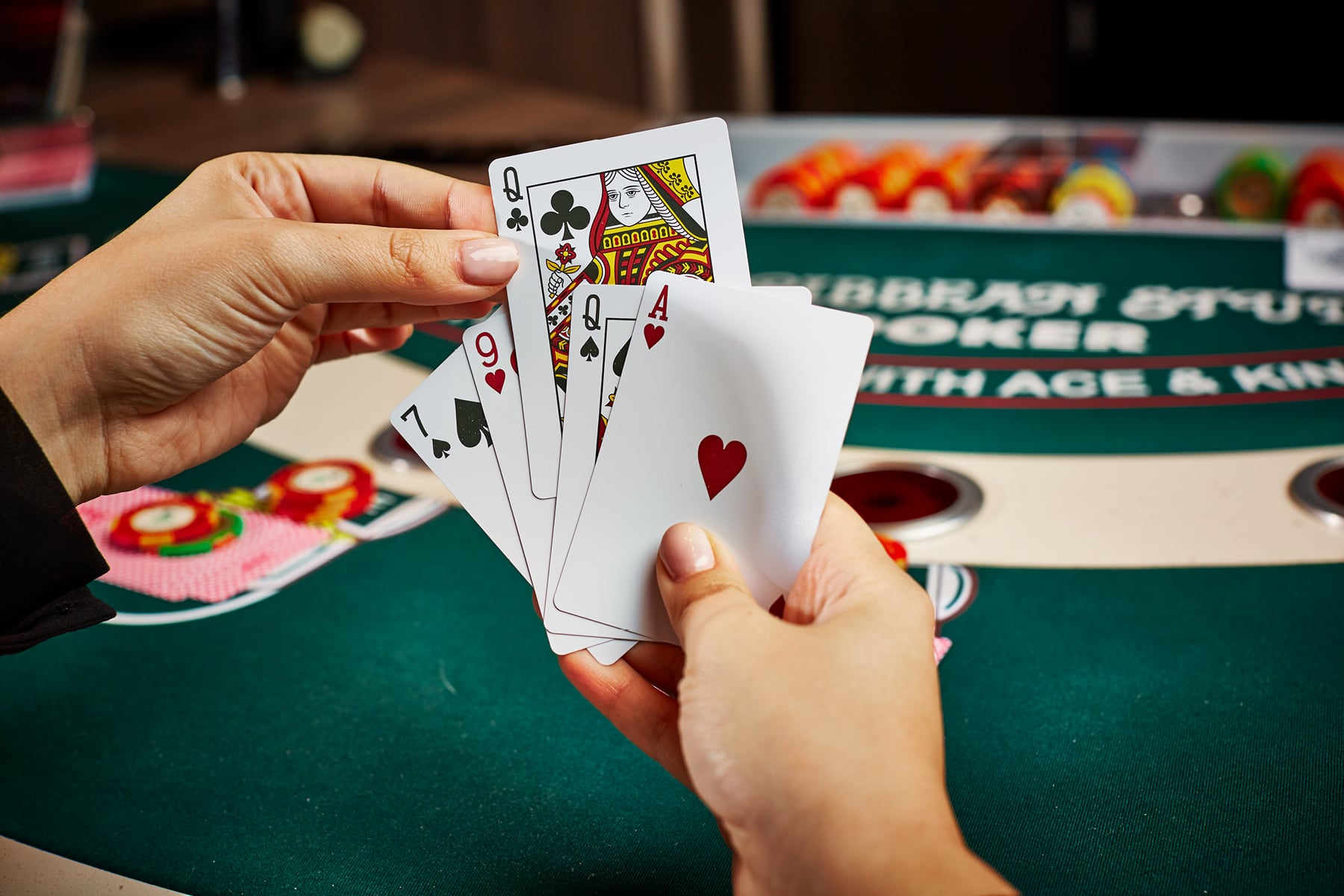
How to Play Caribbean Stud Poker: Complete Guide to Rules, Payouts, and Strategies
Caribbean Stud Poker is a popular casino table game that combines traditional five-card poker rankings with a straightforward betting structure. Unlike Texas Hold’em or Omaha, where players compete against other participants, Caribbean Stud Poker involves playing directly against the dealer.
The game is particularly appealing to players who enjoy poker combinations but prefer a simpler format without multiple betting rounds, bluffing, or complicated decisions. Each player receives five cards and must decide whether to fold or continue by placing an additional wager.
Although the rules are relatively easy to understand, Caribbean Stud Poker includes several important features, including dealer qualification requirements, different payout levels, and optional progressive jackpot bets.
In this comprehensive guide, we explain how Caribbean Stud Poker works, its hand rankings, betting rules, payouts, mathematical probabilities, and strategies for beginners.
What Is Caribbean Stud Poker?
Caribbean Stud Poker is a casino card game played with a standard 52-card deck. Each participating player receives five cards, and the dealer also receives five cards.
The objective is to form a stronger poker hand than the dealer while following the game’s betting rules.
Unlike traditional poker, Caribbean Stud Poker does not involve competing against other players at the table. Each participant’s hand is evaluated separately against the dealer.
The game typically features two main betting stages:
-
Ante Bet: The initial wager placed before receiving cards.
-
Raise Bet: An additional wager placed when a player decides to continue after examining their hand.
The Raise bet is normally twice the amount of the original Ante.
Players must decide whether their cards are strong enough to justify continuing or whether folding is the better option.
This decision forms the central strategic element of Caribbean Stud Poker.
The History of Caribbean Stud Poker
Caribbean Stud Poker became widely recognized during the late twentieth century as casino operators introduced new poker-based table games.
The game gained popularity partly because it offered familiar poker hand rankings without requiring players to learn the more complicated betting structures associated with traditional poker.
Its name reflects its association with Caribbean casino gaming, although accounts of its precise origins differ.
Over time, Caribbean Stud Poker expanded into major casino markets and became particularly recognizable through its optional progressive jackpot feature.
Today, the game can be found in selected traditional casinos and online gaming environments.
How to Play Caribbean Stud Poker
A standard Caribbean Stud Poker round follows a simple sequence.
Step 1: Place the Ante Bet
Before the cards are dealt, each player places an Ante wager.
The amount must fall within the table’s minimum and maximum betting limits.
Some casinos also offer an optional progressive jackpot wager, which is placed separately from the Ante.
Step 2: Receive Five Cards
The dealer distributes five cards to each player and five cards to themselves.
The player’s cards are dealt face down.
The dealer normally reveals one card while keeping the remaining four cards face down.
Players can examine their own cards and consider the dealer’s visible card before deciding how to proceed.
Step 3: Choose to Fold or Raise
After examining the cards, each player must make a decision.
Fold: The player gives up the hand and loses the original Ante wager.
Raise: The player continues by placing an additional wager equal to twice the Ante.
For example, if the original Ante is $10, continuing requires a $20 Raise bet.
The player’s total wager becomes $30.
Step 4: Dealer Reveals Their Cards
After all players have made their decisions, the dealer reveals the remaining cards.
The dealer’s hand is evaluated to determine whether it meets the minimum qualification requirement.
Step 5: Compare Hands and Determine Payouts
If the dealer qualifies, the player’s hand is compared with the dealer’s hand.
Winning wagers are paid according to the applicable rules and payout table.
If the dealer does not qualify, the Ante and Raise bets are settled differently.
Understanding this distinction is essential for beginners.
Caribbean Stud Poker Hand Rankings
Caribbean Stud Poker uses the standard five-card poker ranking system.
The strongest hand is a royal flush, while the weakest is a high-card hand.
Royal Flush
A royal flush consists of Ace, King, Queen, Jack, and 10 of the same suit.
It is the strongest possible hand in Caribbean Stud Poker.
Because this combination is extremely rare, it normally receives the highest payout on the Raise bet.
Straight Flush
A straight flush consists of five consecutive cards of the same suit.
For example, 5, 6, 7, 8, and 9 of hearts form a straight flush.
Four of a Kind
Four of a kind consists of four cards of the same rank and one unrelated card.
For example, four Queens and a 3 form this combination.
Full House
A full house contains three cards of one rank and two cards of another rank.
For example, three Kings and two 8s form a full house.
Flush
A flush consists of five cards of the same suit that do not form a straight flush.
Straight
A straight consists of five consecutive cards, regardless of suit.
For example, 6, 7, 8, 9, and 10 of different suits form a straight.
Three of a Kind
Three of a kind contains three cards of the same rank and two unrelated cards.
Two Pair
Two pair consists of two cards of one rank, two cards of another rank, and one additional card.
One Pair
A pair consists of two cards of the same rank and three unrelated cards.
High Card
If a hand does not contain any qualifying poker combination, its strength is determined by its highest card.
If both hands have the same highest card, the remaining cards are compared in descending order.
Caribbean Stud Poker Hand Rankings Table
|
Hand |
Example |
Ranking |
|---|---|---|
|
Royal Flush |
A♥ K♥ Q♥ J♥ 10♥ |
Highest |
|
Straight Flush |
5♠ 6♠ 7♠ 8♠ 9♠ |
Second |
|
Four of a Kind |
Q♣ Q♦ Q♥ Q♠ 3♣ |
Third |
|
Full House |
K♠ K♥ K♦ 8♣ 8♥ |
Fourth |
|
Flush |
A♦ J♦ 8♦ 5♦ 2♦ |
Fifth |
|
Straight |
6♣ 7♦ 8♠ 9♥ 10♣ |
Sixth |
|
Three of a Kind |
9♠ 9♥ 9♦ K♣ 4♠ |
Seventh |
|
Two Pair |
J♣ J♦ 6♠ 6♥ 3♣ |
Eighth |
|
One Pair |
A♠ A♦ 10♣ 7♥ 4♣ |
Ninth |
|
High Card |
A♣ J♦ 9♠ 6♥ 2♣ |
Lowest |
These rankings determine which hand wins when the dealer qualifies.
What Is Dealer Qualification in Caribbean Stud Poker?
One of the most important rules in Caribbean Stud Poker is the dealer qualification requirement.
In standard versions, the dealer must have at least Ace-King high to qualify.
This means the dealer must hold either a pair or better, or a high-card hand containing both an Ace and a King.
For example, a dealer holding Ace, King, 9, 6, and 3 qualifies.
However, a dealer holding Ace, Queen, Jack, 8, and 4 does not qualify because the hand is weaker than Ace-King high.
The qualification rule affects how winning wagers are paid.
What Happens If the Dealer Does Not Qualify?
If the dealer fails to qualify, the player’s Ante bet typically pays 1 to 1.
The Raise bet is returned without additional winnings.
For example, suppose a player places a $10 Ante and a $20 Raise.
If the dealer does not qualify, the player receives $10 in Ante profit, and both original wagers are returned.
The player earns $10 in profit rather than receiving a payout on the Raise.
What Happens If the Dealer Qualifies?
If the dealer qualifies, the player’s hand is compared with the dealer’s hand.
If the player has the stronger hand, the Ante normally pays 1 to 1, while the Raise pays according to the game’s payout table.
If the dealer has the stronger hand, both wagers lose.
If the hands are exactly equal, the result is generally a push, meaning the original wagers are returned.
Caribbean Stud Poker Payout Table
Caribbean Stud Poker typically offers different payouts for winning Raise bets based on the strength of the player’s hand.
A common payout structure is shown below.
|
Poker Hand |
Raise Bet Payout |
|---|---|
|
Royal Flush |
100 to 1 |
|
Straight Flush |
50 to 1 |
|
Four of a Kind |
20 to 1 |
|
Full House |
7 to 1 |
|
Flush |
5 to 1 |
|
Straight |
4 to 1 |
|
Three of a Kind |
3 to 1 |
|
Two Pair |
2 to 1 |
|
One Pair |
1 to 1 |
|
High Card |
1 to 1 |
These payouts generally apply when the dealer qualifies and the player’s hand wins.
The Ante usually pays even money regardless of the strength of the winning hand.
For example, suppose a player places a $10 Ante and a $20 Raise and finishes with a flush.
If the dealer qualifies but has a weaker hand, the Ante earns $10 in profit.
The Raise pays 5 to 1, producing $100 in profit.
The player’s total profit is therefore $110, in addition to the return of the original wagers.
Actual payouts and maximum prize limits may vary between casinos.
What Is the Progressive Jackpot in Caribbean Stud Poker?
Many versions of Caribbean Stud Poker offer an optional progressive jackpot wager.
This additional bet gives players an opportunity to receive special payouts for rare poker combinations.
A progressive jackpot grows as qualifying wagers contribute to the prize pool.
Depending on the rules, a royal flush may award the entire jackpot, while other strong hands may receive fixed payouts or a percentage of the accumulated prize.
For example, a progressive jackpot paytable might include rewards for:
-
Royal Flush
-
Straight Flush
-
Four of a Kind
-
Full House
-
Flush
The exact qualifying combinations and payout amounts depend on the casino.
Progressive jackpot wagers are separate from the main Ante and Raise bets.
They also have their own mathematical expectations and may carry a higher house edge than the standard game.
Players should review the jackpot rules carefully rather than assuming that the possibility of a large prize makes the wager favorable.
Caribbean Stud Poker Odds and Probabilities
Caribbean Stud Poker uses a standard 52-card deck, creating 2,598,960 possible five-card poker hands.
Some combinations occur much more frequently than others.
For example, a high-card hand is relatively common, while a royal flush is extremely rare.
The table below shows the approximate probabilities of receiving different five-card poker hands.
|
Poker Hand |
Number of Combinations |
Probability |
|---|---|---|
|
Royal Flush |
4 |
0.000154% |
|
Straight Flush (excluding Royal Flush) |
36 |
0.001385% |
|
Four of a Kind |
624 |
0.0240% |
|
Full House |
3,744 |
0.1441% |
|
Flush (excluding Straight Flush) |
5,108 |
0.1965% |
|
Straight (excluding Straight Flush) |
10,200 |
0.3925% |
|
Three of a Kind |
54,912 |
2.1128% |
|
Two Pair |
123,552 |
4.7539% |
|
One Pair |
1,098,240 |
42.2569% |
|
High Card |
1,302,540 |
50.1177% |
These probabilities describe the distribution of five-card hands from a standard deck.
They do not represent the player’s overall probability of winning a Caribbean Stud Poker round.
The final outcome also depends on the dealer’s cards, qualification requirements, and the player’s decision to fold or raise.
Basic Caribbean Stud Poker Strategy
Caribbean Stud Poker offers fewer strategic decisions than traditional poker, but choosing whether to fold or raise can affect the expected outcome.
A mathematically informed strategy considers both the player’s cards and the dealer’s visible card.
Raise With a Pair or Better
A commonly recommended basic principle is to raise when holding a pair or a stronger poker hand.
These combinations generally provide enough strength to justify continuing under standard rules.
However, having a pair does not guarantee victory because the dealer may receive a stronger hand.
Fold Weak Hands
Players holding weak high-card combinations should generally consider folding rather than automatically placing the additional Raise bet.
Continuing with every hand can increase expected losses.
Understand Ace-King Decisions
Ace-King high is an important category in Caribbean Stud Poker because it is close to the dealer’s minimum qualification threshold.
However, not every Ace-King hand should be played in exactly the same way.
The correct decision can depend on the player’s remaining cards and the dealer’s visible card.
Optimal strategy for borderline Ace-King hands is more detailed than simply raising whenever an Ace and King are present.
Use a Reliable Strategy Chart
A Caribbean Stud Poker strategy chart can provide guidance for deciding when to raise or fold.
For the most accurate recommendations, players should use a chart designed for the specific rules and payout structure of the game.
Even an optimal strategy cannot guarantee winning individual hands.
Caribbean Stud Poker House Edge
The house edge represents the casino’s mathematical advantage over players over a large number of rounds.
In Caribbean Stud Poker, the house edge depends on the game’s rules, payout structure, and the player’s decisions.
Under commonly used standard rules and optimal strategy, the house edge is approximately 5.22% when measured against the initial Ante wager.
Because players sometimes place an additional Raise bet, the expected loss expressed as a percentage of the total amount wagered can be lower.
These different calculation methods should not be confused.
A house edge of 5.22% does not mean a player will necessarily lose exactly 5.22% of their money during a particular session.
Actual results can vary substantially because the cards are dealt randomly.
Caribbean Stud Poker vs. Three Card Poker
Caribbean Stud Poker and Three Card Poker share several characteristics.
Both involve playing against the dealer rather than other players, and both require decisions after the initial cards are dealt.
However, there are important differences.
Caribbean Stud Poker uses five cards per hand, while Three Card Poker uses three.
The hand-ranking systems are also different because the probability of particular combinations changes with the number of cards.
In Caribbean Stud Poker, the Raise is typically twice the Ante.
In standard Three Card Poker, the Play wager is usually equal to the Ante.
Dealer qualification requirements also differ. Caribbean Stud Poker generally requires Ace-King high or better, while Three Card Poker typically requires Queen-high or better.
These differences create distinct betting strategies and mathematical expectations.
Caribbean Stud Poker vs. Texas Hold’em
Although Caribbean Stud Poker uses traditional poker hand rankings, it differs significantly from Texas Hold’em.
Texas Hold’em involves competing against other players through multiple betting rounds.
Participants use two private cards and five community cards to form their strongest five-card hand.
Caribbean Stud Poker gives each player five cards immediately.
There are no community cards, and players do not exchange cards or attempt to bluff the dealer.
The primary decision is whether to fold or raise.
As a result, Caribbean Stud Poker has a simpler strategic structure than Texas Hold’em.
However, players still benefit from understanding poker combinations and probabilities.
Online Caribbean Stud Poker
Caribbean Stud Poker is available through selected online casino platforms.
Digital versions typically use automated card dealing and interactive betting interfaces.
Players can examine their five cards, view the dealer’s exposed card, and choose whether to fold or raise.
Some platforms may offer additional features, including optional jackpots or different payout structures.
Before participating, players should review the game’s rules, betting limits, payout table, and licensing information.
Online gambling laws differ between jurisdictions, so players should verify whether participation is permitted in their location.
Common Caribbean Stud Poker Mistakes
Beginners sometimes make decisions without fully understanding the rules or mathematical structure of the game.
Raising with every hand: Continuing regardless of card strength can increase expected losses.
Ignoring the dealer’s visible card: The exposed dealer card provides information that may influence borderline decisions.
Confusing dealer qualification with winning: A dealer who fails to qualify does not trigger a normal Raise payout. The Ante generally wins while the Raise is returned.
Misunderstanding progressive jackpots: Optional jackpot bets have separate payout rules and probabilities.
Assuming a strong hand guarantees victory: Even a relatively strong poker combination can lose to a better dealer hand.
Overlooking the payout table: Different versions may offer different rewards or maximum payouts.
Chasing losses: Increasing wagers after losing does not improve the probability of receiving stronger cards.
Playing without a budget: Establishing spending limits can help prevent gambling expenses from exceeding an affordable amount.
Is Caribbean Stud Poker a Game of Luck or Skill?
Caribbean Stud Poker combines random card distribution with limited strategic decision-making.
Players cannot control which cards they receive or which cards are dealt to the dealer.
However, they can decide whether to fold or continue after examining their hand and the dealer’s exposed card.
These decisions affect the expected financial outcome of the game.
Understanding poker hand rankings and using an appropriate strategy can reduce unnecessary losses.
Nevertheless, even optimal play does not eliminate the casino’s mathematical advantage under standard rules.
Caribbean Stud Poker should therefore be considered a game of chance with a strategic decision-making component.
Responsible Caribbean Stud Poker Play
Like other casino games, Caribbean Stud Poker involves financial risk.
Players should establish a spending limit before participating and avoid using money needed for essential expenses.
It is also important to understand that placing a Raise bet increases the amount at risk during a round.
Optional jackpot wagers can further increase spending.
Players should avoid chasing losses or assuming that a series of unsuccessful hands makes a winning hand more likely.
Taking regular breaks and setting time limits can help maintain realistic expectations.
Gambling should be treated as entertainment rather than a dependable source of income.
Frequently Asked Questions About Caribbean Stud Poker
How many cards are used in Caribbean Stud Poker?
Each player receives five cards, and the dealer also receives five cards. The game uses a standard 52-card deck.
What is the minimum dealer qualifying hand?
In standard Caribbean Stud Poker, the dealer must have at least Ace-King high to qualify.
How much is the Raise bet?
The Raise bet is normally twice the original Ante wager.
Can players exchange cards?
No. Players generally cannot exchange or draw additional cards after receiving their initial five-card hand.
What happens if the dealer does not qualify?
The Ante typically pays 1 to 1, while the Raise bet is returned without additional winnings.
What is the strongest hand?
A royal flush is the strongest possible hand in standard Caribbean Stud Poker.
Is the progressive jackpot mandatory?
No. Progressive jackpot wagers are normally optional and separate from the main game.
Can players use strategy?
Yes. Players can use mathematically informed decisions to determine when to fold or raise, but no strategy guarantees a profit.
Is Caribbean Stud Poker the same as Texas Hold’em?
No. Caribbean Stud Poker is a casino game played against the dealer, while Texas Hold’em is a competitive poker format involving multiple players and community cards.
Conclusion
Caribbean Stud Poker is an entertaining casino card game that combines traditional five-card poker rankings with a relatively simple betting structure.
Its main feature is the decision to fold or raise after examining five cards and the dealer’s visible card.
Understanding the dealer qualification requirement, Ante and Raise payouts, and standard poker hand rankings is essential for beginners.
Although strategy can improve decision-making, the outcome of each round still depends on randomly dealt cards, and the casino retains a mathematical advantage under standard rules.
Players should review the paytable, understand the risks associated with optional jackpot wagers, and establish clear spending limits before participating.
With a solid understanding of the rules and realistic expectations, beginners can better appreciate how Caribbean Stud Poker differs from other popular casino poker games.
Reference: betforward